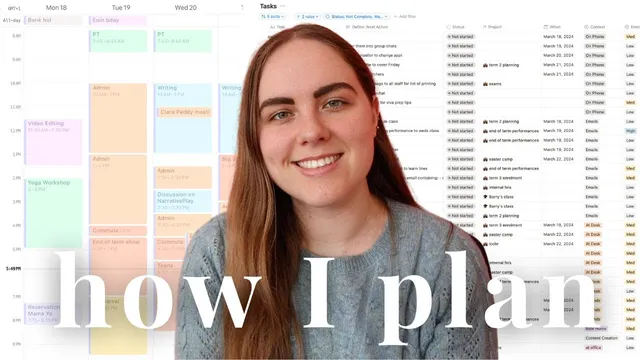
My 4 Step Weekly Planning Routine | GTD
Based on Ciara Feely's video on YouTube. If you like this content, support the original creators by watching, liking and subscribing to their content.
Use a four-step weekly loop: reflect on the past week, brain dump everything still in your head, organize tasks into next actions by context, then schedule them into calendar blocks.
Briefing
A four-part weekly planning routine—reflection, brain dumping, task organization, and scheduling—turns a chaotic workload into a manageable week by forcing tasks into clear “next actions” and time/context blocks. The core idea is simple but powerful: the mind should stop holding onto open loops. Once everything is captured outside the head and then broken down into actionable steps, the week becomes less about remembering and more about executing.
The process starts with reflection on the week just finished: what went well, what didn’t, and what patterns show up. A personal example is a recurring struggle on Thursdays, which becomes a cue to plan gentler expectations for that day. Reflection also feeds goal-setting—checking whether current responsibilities and life areas (business, personal commitments, health, relationships) are being served—and it helps decide what to keep, let go of, or do more of. This isn’t limited to work; it includes social plans, workouts, and family logistics.
Next comes brain dumping, recommended at least weekly. The routine treats the brain as an idea generator, not a storage system. Following David Allen’s “Getting Things Done” philosophy, the planner is used to offload every lingering task—urgent items, “someday” ideas, and worries—so they don’t resurface at inconvenient moments. The dump can include everything from printing performance materials and sending end-of-term emails to scheduling meetings, responding to parents, buying gifts, and preparing content. The key is that the dump is comprehensive, even if many items won’t be tackled immediately.
The most distinctive step is task organization, which the routine frames as the most overlooked productivity skill. Instead of maintaining a raw list, each item is converted into a specific next action. A task like “print performance pieces” isn’t treated as actionable until the missing dependency is identified—requesting the exact list of what to print from other teachers. Tasks are then sorted by context: email work, Slack communication, phone/text tasks, desk-based work (writing, editing, file prep), and location-based errands or office tasks. Context grouping reduces the cost of switching between task types, with the routine citing roughly a 17-minute penalty for context changes.
Priority is deliberately de-emphasized because everything feels important; effort and time estimates take its place. By summing time requirements (e.g., total email time), the planner can match tasks to available calendar space.
Finally, scheduling locks the plan into the week. Non-removable calendar items—classes, performances, and meetings—set the boundaries. Remaining blocks (often 3-hour stretches) are assigned to deep work like research writing, admin blocks for email/phone tasks, and smaller windows for desk tasks and errands. The result is a weekly rhythm that balances high-focus work with operational tasks while still leaving room for personal life—like gift shopping and meal prep—without relying on last-minute memory.
Cornell Notes
The routine uses a four-step weekly system—reflection, brain dumping, task organization, and scheduling—to prevent overwhelm and make execution easier. Reflection identifies what’s working and what’s not, including recurring trouble spots (like Thursdays) and whether goals across work and life are being met. Brain dumping captures everything in one place so the mind stops “reminding” at the wrong times; it’s especially helpful for people who struggle to fall asleep from mental clutter. Task organization turns vague items into clear next actions and groups them by context (email, phone, desk, location) to reduce costly context switching. Scheduling then assigns these organized tasks into calendar blocks, using deep-work time for writing and admin time for communication-heavy work.
Why does the routine treat brain dumping as more than simple note-taking?
How does task organization reduce overwhelm when weekly task lists grow to dozens of items?
What does “context” mean in this planning system, and how is it used?
Why does the routine avoid traditional priority ranking?
How does scheduling translate organized tasks into a workable week?
What role does reflection play in improving future weeks?
Review Questions
- Which step in the routine most directly prevents vague tasks from stalling progress, and what specific technique is used to fix it?
- How does grouping tasks by context change scheduling decisions compared with a simple chronological to-do list?
- What kinds of information belong in brain dumping, and why does capturing “someday” items still matter for reducing mental load?
Key Points
- 1
Use a four-step weekly loop: reflect on the past week, brain dump everything still in your head, organize tasks into next actions by context, then schedule them into calendar blocks.
- 2
Convert every task into a concrete next action by identifying missing dependencies (e.g., “print performance pieces” becomes “request the list of pieces from teachers”).
- 3
Sort tasks by context—email, Slack, phone/text, desk work, and location-based errands—so work blocks match how the task must be done.
- 4
De-emphasize priority ranking when nearly everything feels important; instead estimate time/effort and fit tasks into available blocks.
- 5
Schedule deep work (like research writing) into protected, larger blocks and reserve admin blocks for communication-heavy tasks.
- 6
Use reflection to detect recurring problem days (such as Thursdays) and adjust expectations and planning accordingly.
- 7
Capture both urgent tasks and longer-term or “someday” items during brain dumping so they don’t keep resurfacing as mental noise.