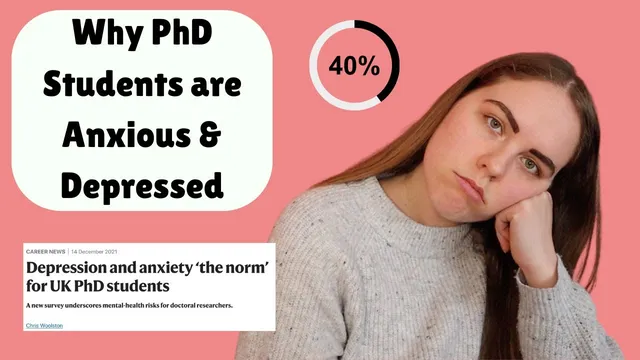
Why PhD Students are Anxious and Depressed - Strategies to Take Care of Mental Health During a PhD
Based on Ciara Feely's video on YouTube. If you like this content, support the original creators by watching, liking and subscribing to their content.
Cited research links PhD training with unusually high rates of severe depression or anxiety (about 40%), alongside normalization of distress and consideration of leaving programs.
Briefing
PhD life is strongly associated with anxiety and depression, with research cited here putting roughly 40% of doctoral students in the range for severe depression or anxiety—well above the 25–30% seen in similarly aged working professionals. The fallout is not just internal: many students normalize distress, consider taking time off, and a sizable share contemplate dropping out. Even as mental-health conversations have grown, stigma and shame remain common, leaving many people to suffer quietly while trying to “dissect” their feelings without always finding clear answers.
A central thread links that distress to “connections” that can erode during doctoral training—especially when the work becomes isolating, values get sidelined, and the future feels unstable. Drawing on Johann Hari’s Lost Connections, the discussion frames anxiety and depression as often tied to changeable lifestyle and social factors rather than only medical fixes. The approach is not presented as a substitute for professional care; it’s offered as a practical lens. The “quick fix” critique targets an overreliance on medication without addressing underlying drivers—illustrated by a dehydration-and-headache analogy: symptom relief can mask the real problem until new symptoms appear.
The breakdown of lost connections maps closely onto PhD realities. Meaningful work can slip away over a long program, especially if students lose sight of why their research matters; staying anchored to the purpose set out in proposals, plus building motivation through long-term vision and shorter goals, is offered as a counterweight. Loneliness and lack of belonging are treated as predictable in a solitary PhD environment; strategies include using social media to find peers who “get it,” joining university-wide PhD societies, and developing buddy systems or peer groups for real-time support.
Values are another pressure point. The routine of constant consumption—endless scrolling, low-value busyness, and neglecting health, relationships, and hobbies—can leave students feeling off-kilter. The suggested remedy is to identify core values (curiosity, success, health, creativity, pleasure) and deliberately schedule leisure and recovery so the PhD doesn’t swallow everything. Childhood-learned coping patterns also get attention: behaviors like people-pleasing can intensify during doctoral training, driving overwork and burnout. The guidance is to recognize these patterns and seek professional support when needed.
Status and future security round out the picture. Imposter syndrome and belonging doubts are framed as a paradox of PhD life—high achievement in one sense, but low status and early-career insecurity in another. Tracking inputs and achievements is offered as a way to counter the tendency to discount one’s effort. Nature is treated as a simple but often neglected stabilizer, with greener environments linked to lower stress and nature breaks tied to creativity.
Finally, the future can feel “hope-less” because job security in academia is uncertain and financial pressure is real. The response is to clarify desired outcomes, set structured short-term goals (the speaker uses 12-week cycles), and—controversially—consider a side hustle for added security. The discussion closes by emphasizing that genetics account for only a minority of depression risk, while neuroplasticity means change is possible; the most important step, regardless of cause, is to talk to someone and get support.
Cornell Notes
The discussion ties PhD anxiety and depression to erosion of several “connections” that support mental health: meaningful work, other people, personal values, and a secure future. It cites a Nature-linked statistic that about 40% of PhD students meet criteria for severe depression or anxiety, with many normalizing distress and considering leaving or taking time off. Using Johann Hari’s Lost Connections as a framework, it argues that lifestyle and social factors—often changeable—can drive symptoms, and that symptom-masking alone (e.g., relying only on drugs) may miss root causes. Practical strategies include anchoring research purpose, building peer support, scheduling leisure aligned with values, addressing learned coping patterns like people-pleasing, and reducing uncertainty through goal-setting and financial contingency planning. Professional help is repeatedly emphasized as essential.
Why does distress become so common during a PhD, and what does the cited prevalence suggest?
How does the “lost connections” framework map onto doctoral life?
What concrete steps are suggested to restore “meaningful work” and motivation?
How does the discussion address loneliness and belonging during a PhD?
What does “values” mean here, and how is it turned into a schedule?
What strategies are offered for “hopeful and secure future” when academia feels precarious?
Review Questions
- Which “lost connections” in the framework seem most directly tied to your own PhD stressors, and why?
- How would you translate “values” into a weekly schedule without sacrificing research progress?
- What would a 12-week action step look like if your goal were to increase career security beyond academia?
Key Points
- 1
Cited research links PhD training with unusually high rates of severe depression or anxiety (about 40%), alongside normalization of distress and consideration of leaving programs.
- 2
A lifestyle-and-social “lost connections” lens argues that changeable factors—meaning, belonging, values, and future security—often drive symptoms, not only medical treatment.
- 3
Meaningful work can erode over long doctoral timelines; keeping the research’s purpose visible through proposals, long-term vision, and goal alignment is presented as protective.
- 4
Loneliness is treated as predictable in PhD life; peer networks, university societies, buddy systems, and carefully used social media can reduce isolation.
- 5
Neglecting personal values—health, relationships, hobbies, creativity—can worsen mood; identifying values and scheduling leisure intentionally helps restore balance.
- 6
Learned coping patterns like people-pleasing can intensify during PhDs, fueling overwork and burnout; awareness and professional support are recommended.
- 7
Future uncertainty and financial pressure can sustain chronic stress; clarifying desired outcomes and using structured goal cycles (plus contingency planning like side income) can improve perceived security.